Today, I am delighted to welcome Sam Mee to the blog. Sam is founder of the Antique Ring Boutique (https://antiqueringboutique.com/), based in London (hence the British spellings in the article!), which sells authentic rings from the Georgian, Victorian, Edwardian, and Art Deco eras. He doesn’t sell Tudor jewelry – not much has survived and what does is in museums, where it belongs – but he is particularly interested by the era “as sumptuary laws were at their height, yet especially in Elizabeth’s time there was growing demand for jewellery from the rising merchant classes. Meanwhile portraits of the Tudor rulers used jewellery as part of their projection of authority and power.” He approached me about writing this post – and it became enormously topical when the British Museum acquired the fabulous Tudor Heart piece linked to Henry VIII and Catherine of Aragon last month!
Without further ado, I turn you over to Sam…
***
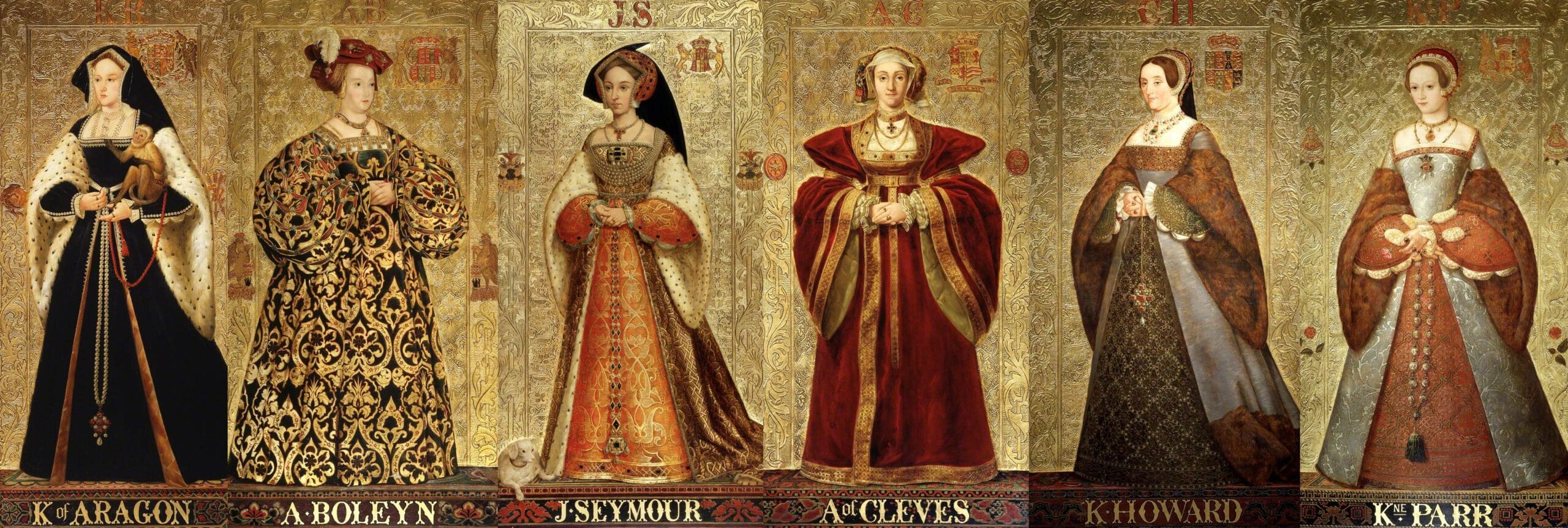
Few artefacts reveal the lives of Henry VIII’s six wives more than their jewels. Gold, enamel, pearls and pendants weren’t just ornaments but ways to make statements and express individuality within the strict confines of queenship. Few Tudor jewels survive but their splendour and visual language are apparent in the many paintings that we do have.
The Six Queens and Their Jewels
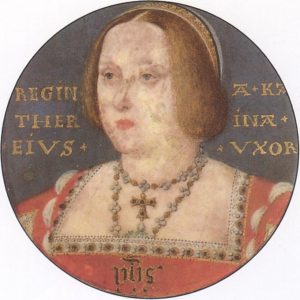
Catherine of Aragon was Henry’s first wife: (born 1485, married from 1509 until annulled in 1533, died 1536). Her Spanish taste and devout Catholicism were prominent – there’s a Horenbout miniature at the National Portrait Gallery in which she wears a gold chain supporting a distinctive Tau-shaped cross, a symbol of Franciscan humility. She also has a jewelled brooch bearing the Christogram IHS (a monogram for Jesus Christ formed from an abbreviation of his name). Ambassadorial dispatches from the time describe her as richly dressed yet modest in ornament. Her jewellery aimed to embody both piety and magnificence.
Next up was Anne Boleyn (born in the early 1500s, married from 1533 to 1536 when she was beheaded for treason). She brought a different aesthetic to Henry’s court and her style was a clear break with the former Queen. Her French education had exposed her to Renaissance elegance, with slim silhouettes, open necklines and refined ornament. There’s a famous Hever Rose portrait in which Anne wears an iconic “B” pendant strung with three pearls. This image has been endlessly reproduced and captures her individuality and (over) confidence in her self-assurance. Documents from the time confirm that she received jewels directly from Henry, including French settings and gemstones. But her monogrammed necklace was a radical departure from the royal and devotional jewellery of her predecessors.
After Anne’s execution, there was a mixture of contrast and conformity in Jane Seymour’s style (born 1508, Queen from 1536 until her death in 1537 following childbirth). Holbein’s portrait of her in the Kunsthistorisches Museum, Vienna, depicts her with an IHS pendant like Catherine’s. Overall, though, her use of jewels was restrained, reflecting both her short tenure and her role as attempted reconciler after years of turmoil. Her wardrobe accounts list gems in far smaller quantities than her predecessors’.
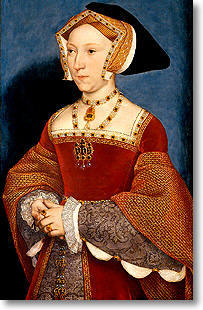
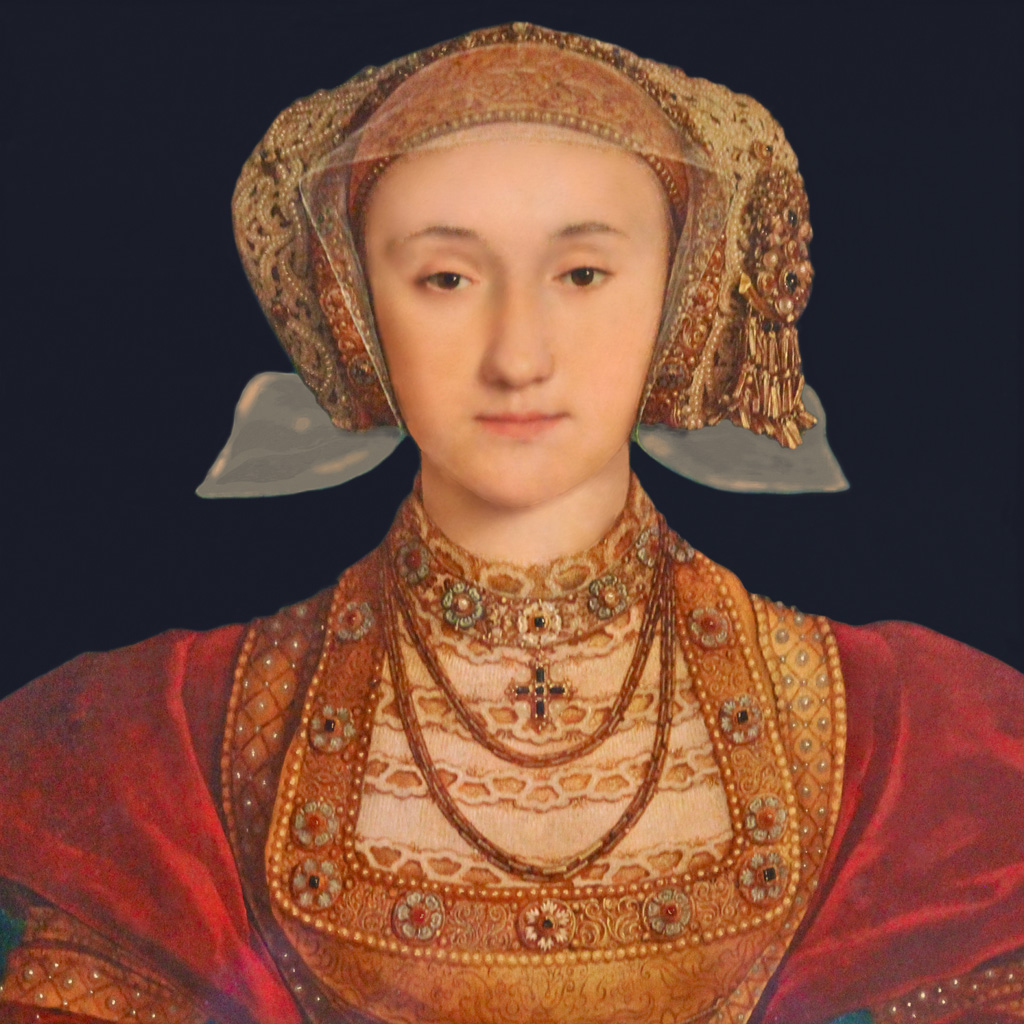
After Jane’s death came another foreign match in Anne of Cleves (born 1515, married Henry in 1540, annulled the same year and died in 1557). She entered the Tudor court adorned in continental splendour. Hans Holbein’s celebrated portrait shows her with broad gold chains, gem-studded girdles and a heavily jewelled headdress. These German styles were unfamiliar to the English court. Sadly Henry was disappointed by her physical appearance (as featured in The Mirror and the Light on the BBC) so she didn’t last long either.
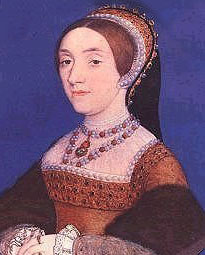
The fifth queen brought youth back to court in the form of Catherine Howard (born 1523, married from 1540 to 1541 but beheaded in 1542 on the grounds of treason and adultery with her distant cousin, Thomas Culpeper). There are few authenticated portraits – possibly scrubbed from history by Henry – and a miniature long identified as her is now considered to potentially be another sitter. If accurate, it shows a lavishly jewelled bodice set with diamonds and seed pearls. Records of Henry’s gifts include diamond girdles and pearl necklaces, tokens of his love that were later cited in her downfall. The fact she had given or shown these gifts to others was used as evidence against her. Her jewels reflected her brief ascendancy and the dangers of female display in a jealous court.
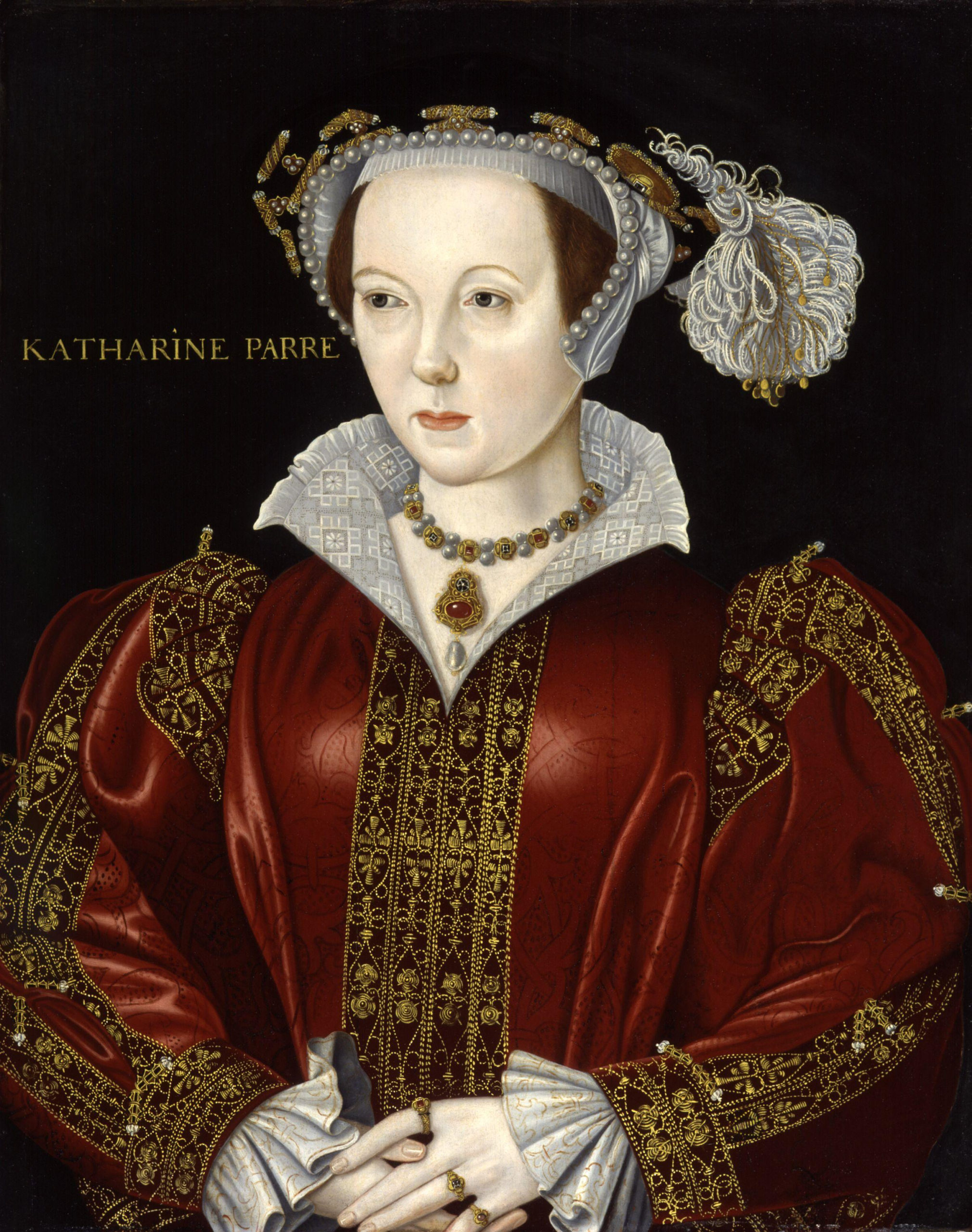
Matters then turned full circle with Catherine Parr (born 1512, queen from 1543 until Henry’s death in 1547; she died in 1548). This Catherine helped restore the dignity of the queen’s image, lasting longer in the role than the previous four women. In one portrait of her, The Sudeley Miniature by Lucas Horenbout, she wears layered pearls, a richly jewelled girdle chain and most significantly the Tau cross pendant first seen on Catherine of Aragon. Another portrait of her contains a pendant with three pearls, perhaps an echo of Anne Boleyn’s. And a third shows her with a girdle possibly inherited from Catherine Howard.
The Tau Cross: Bookending the Tudor Court
There has long been a theory that the Tau cross pendant is perhaps the most potent symbol linking the first and last of Henry’s wives. Its T-shape is associated with St. Anthony and the Franciscan Order and signified both humility and piety. For the Catholic Catherine of Aragon, it represented personal devotion. Catherine Parr leaned toward reformist Protestantism yet perhaps wore it as a visual echo of earlier queenship and a gesture of stability amid religious division.
That it appears in portraits of both women suggests it was a royal jewel passed through the consort’s inventory, as other pieces were. Its survival across two religiously opposed reigns makes it an emblem of dynastic continuity. The Tau cross bookends Henry’s marital history: from the devout Catholic wife he cast aside to the reform-minded queen who outlived him.
One slight issue with this theory is that of the three surviving contemporary pictures of Catherine Parr (you can see them here: https://tudortreasures.net/the-real-face-of-catherine-parr/), some historians now believe the first of these, the miniature with the Tau cross, is not in fact Catherine (read more here: https://www.theguardian.com/uk-news/2024/nov/17/after-decades-tiny-500-year-old-royal-portrait-is-identified-as-mary-tudor).
The “B” Pendant
Anne Boleyn’s “B” pendant remains one of the most recognisable images of the Tudor age and marks her out as self-consciously modern. The initial suspended on a string of pearls proclaimed individualism at a time when queens were expected to reflect the King, not eclipse him.
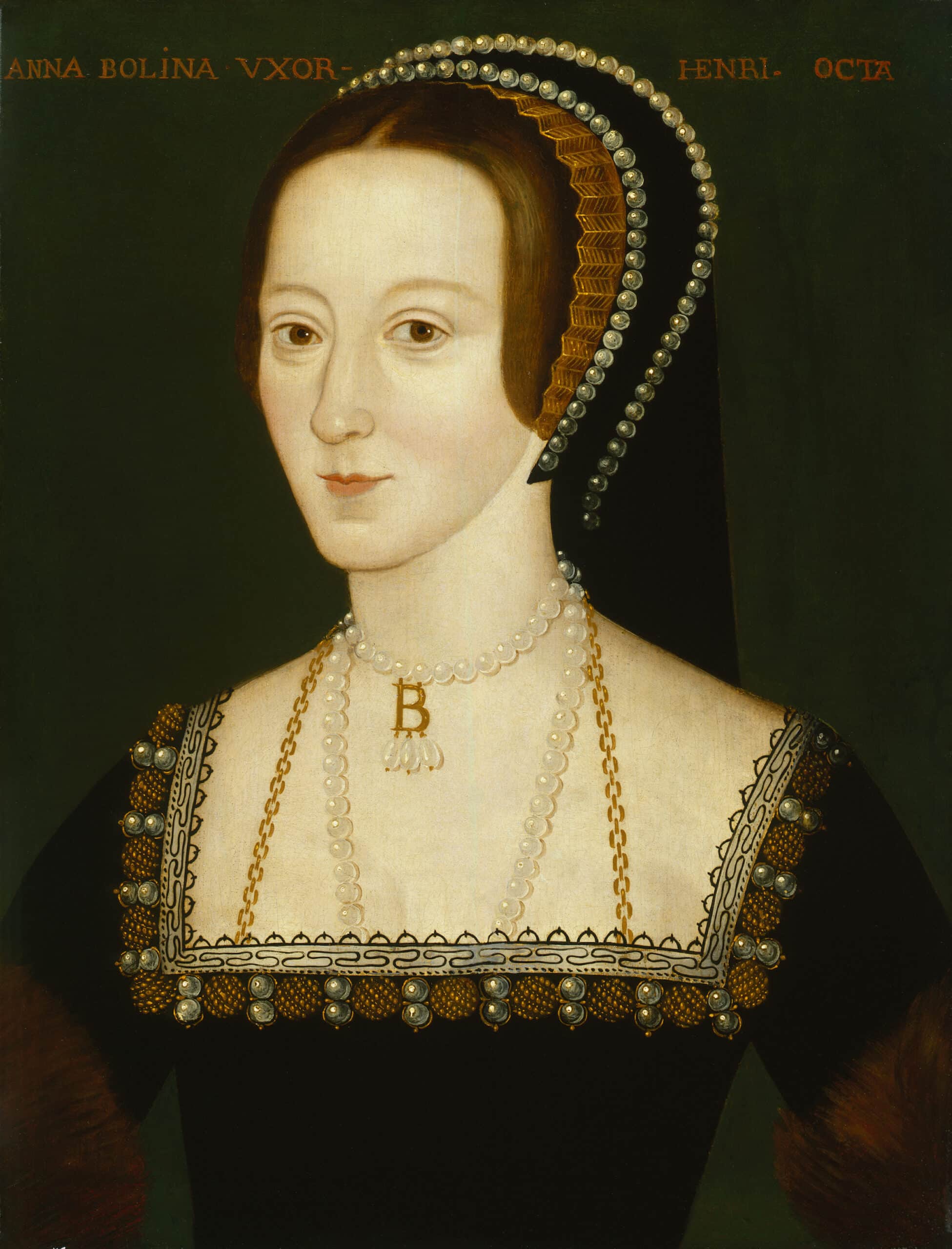
This focus on personal connection rather than the formal divinity intercession of Catherine’s jewellery, lived on after her. Her initial became a symbol of courage in Protestantism’s account of her life, with portraits continuing to reproduce it after her death. Her self-presentation re-shaped the Tudor imagination.
Shared Jewels
Queen Elizabeth’s portraits show her dripping in pearls, emphasising her purity and divine favour. But she did not invent the symbolism. Pearls were the most consistent motif across all six wives, common in all their portraits. But it’s not just that the wives shared similar tastes – inventories from the time suggest that many royal jewels were passed between queens, remounted or adapted for each new consort. The Tau cross is the most visible example (and there’s some suggestion Jane Seymour wore it too). But there were others: diamond girdles, enamelled chains, and gem-set crosses that appear in different guises in successive portraits.
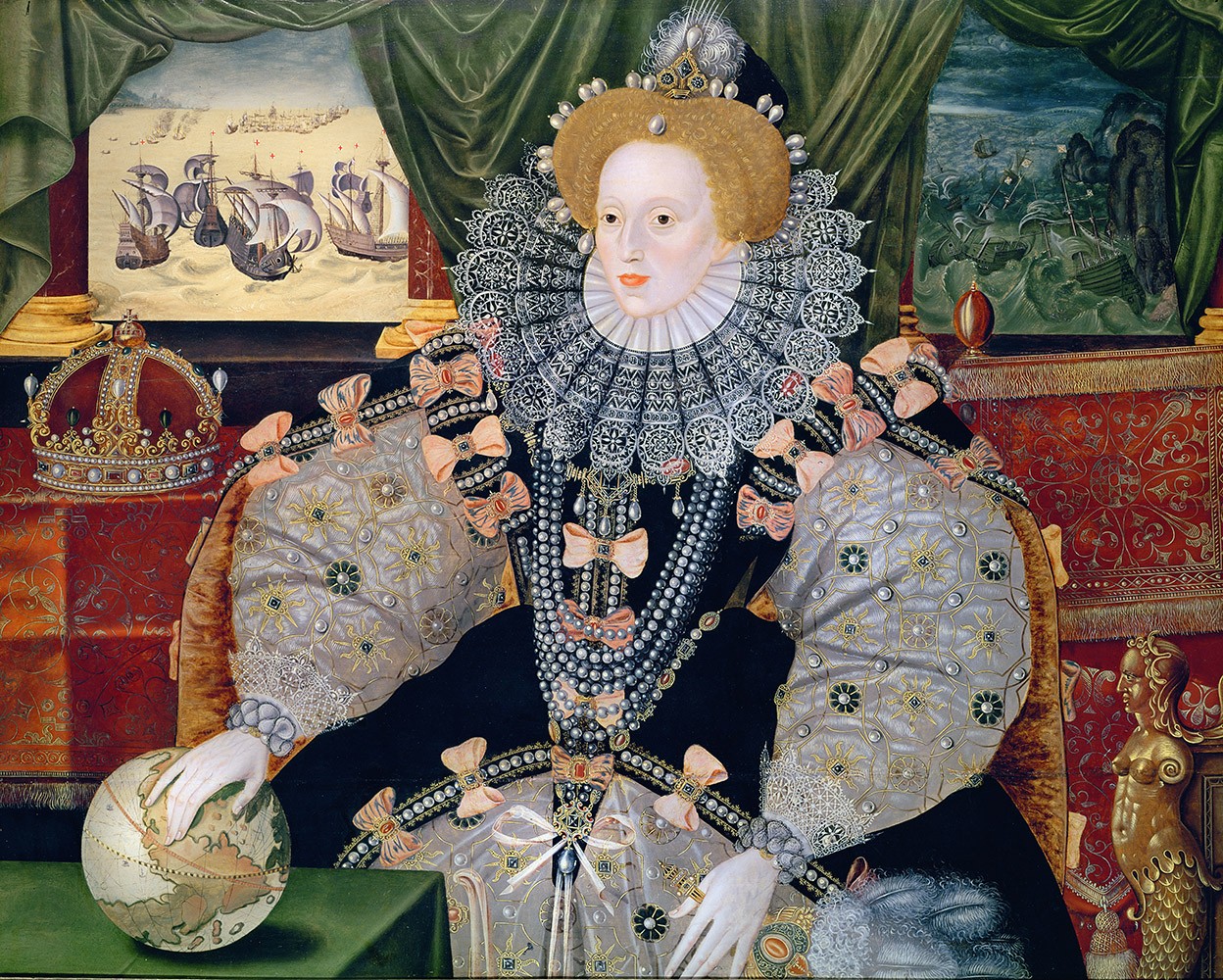
Inventories from the Royal Jewel House list dozens of items that were later identified in portraits. For Henry, this recirculation of jewels between wives reinforced his authority: the queen might change, but the splendour of his monarchy endured. But for the women themselves, these inherited jewels also signalled legitimacy – a visual claim to the same status as predecessors, even those disgraced or dead, and a sign of continuity. Catherine Parr’s adoption of the Tau cross showed continuity with the Catholic queens despite her Protestant sympathies. Jewellery helped bind Henry’s fractured marital history into a coherent image of Tudor queenship.
Global Trade and the Reach of Empire
Looking back, the featured jewellery has a wider meaning as the pieces reflected England’s growing participation in global trade. Pearls arrived via the Portuguese and Spanish empires, plucked from both the Persian Gulf and the Caribbean. Gold came from Africa, sapphires and rubies from Ceylon and Burma and diamonds via Antwerp from the mines of India. By the 1520s, Henry’s court was participating in a European network of gemstone exchange centred on Antwerp and Venice. Many of these imported materials were fashioned by London’s goldsmiths clustered around Cheapside, the city’s jewellery district that served as the heart of Tudor luxury production. There’s a famous discovery – the Cheapside Hoard – that is our richest source of evidence of this trade. You can read more here: https://thehistoryjar.com/2025/10/06/guest-post-monday-how-the-cheapside-hoard-lifted-the-veil-on-elizabethan-society/ and it should go in display in 2026 at the new Museum of London building.
Anne of Cleves’s and Catherine Howard’s jewels in particular demonstrate this cosmopolitanism: the German princess’s richly worked gold chains incorporated gems from across the continent, while Henry’s gifts to his young bride included imported pearls and diamonds. These commodities depended, however, on the trade networks of rival powers. In its opulence, Tudor jewellery embodied the reach and the limits of English power.
Conclusion
Henry’s love life is back in the news right now. The British Museum has launched an appeal to permanently acquire a gold pendant – the Tudor Heart – linked to his marriage to Katherine of Aragon. The 24-carat pendant was dug up by a metal detectorist and the museum is trying to raise £3.5m by April 2026 to stop it entering a private collection.
Whatever the fate of the Tudor Heart, that of Henry VIII’s wives is already widely known. But their jewellery gives a subtler insight into their lives. It reveals the politics, economy and faith of Tudor England – and also shows the attempts of six different women to navigate and negotiate the impossible role of royal consort under a mercurial king.
Further reading:
● What can portraits tell us about the six queens of Henry VIII? https://www.npg.org.uk/schools-hub/what-can-portraits-tell-us-about-the-six-queens-of-henry-viii
● The Tudor Queens’ consort necklace https://tudortreasures.net/the-tudor-queens-consort-necklace/
● A comparison of portraits showing shared jewellery here: https://under-these-restless-skies.blogspot.com/2013/12/recycling-queens-jewels.html
● And another one here: https://tudorsdynasty.com/the-jewels-of-the-tudors-part-one-guest-post/
● The Tudor Heart appeal: https://www.britishmuseum.org/tudor-heart-appeal
***
If you like my posts, you’ll love my books! Nothing Proved is my newest, the story of Elizabeth Tudor’s journey from bastard to queen. Get it now through your favorite platform – Amazon, Barnes & Noble, Kobo, Apple, your own independent bookstore, or even directly from me!
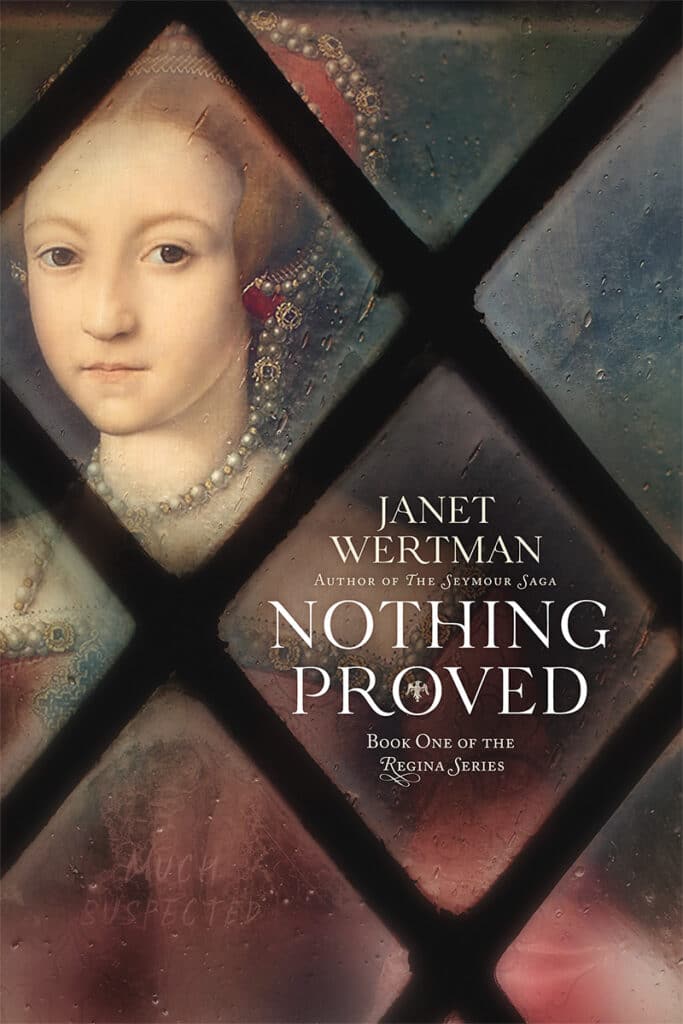
(PS Already read it? Did you love it? Then please review it – even just a stars rating! It makes a huge difference in helping new readers find them and would mean the world to me!)
Be First to Comment