

Today, I am delighted to welcome back Sam Mee to the blog. Many of you will remember Sam from his original article, What Henry’s Wives’ Jewelry Tells Us About the Tudor Court – an article he was the perfect person to write as he is founder of the Antique Ring Boutique, based in London (hence the British spellings in the article!), which sells authentic rings from the Georgian, Victorian, Edwardian, and Art Deco eras (he doesn’t sell Tudor jewelry – not much has survived and what does “is in museums, where it belongs” as he puts it). This follow up is also right in his wheelhouse – who better than a jeweler to know the history of the day on which more jewelry is gifted than any other?
Without further ado, I turn you over to Sam…
***
Modern Valentine’s Day is often explained as an ancient Roman fertility rite, absorbed by Christianity and sentimentalised by the Victorians with Cupid eventually globalised by corporations.
It’s a good story and classical precedents, church calendars and capitalist card companies certainly matter. But the most important steps are missing. First the pivotal transformation of Valentine’s Day into a celebration of romantic love that was initially formalised in medieval England. And second how it survived the cull of saints’ days under Henry VIII. Modern Valentine’s day exists only because of early English literature and Tudor courtly practice.
Saints’ days and the medieval calendar
In the medieval Latin Church, saints’ feast days were not personal anniversaries or moral object lessons in the modern sense. They were communal observances, embedded in a busy annual rhythm of prayer. Saints’ days marked the dies natalis (the saint’s “birth into heaven”) and were moments of collective remembrance.
In particular, saints weren’t associated with the circumstances of their deaths in the allegorical way that we now know them. St Lawrence was not seen as a patron of cooks despite his martyrdom by roasting (nor immediately venerated by comedians despite his near final quip “I’m cooked on this side; turn me over”!). Saints’ cults developed through miracle stories and institutional promotion and not through metaphorical readings of their executions.
The modern theory that St Valentine is associated with romance because he secretly married lovers or defied imperial authority on behalf of love actually rests on legend and is not documented in Christian evidence. So how did we get there?
Valentine or Valentines?
The name “Valentinus” was common in late Roman times and derived from valens meaning strong but there are at least three early saints named Valentine:
- A Roman priest, executed around AD 269
- A bishop of Terni who was martyred around the same period
- A more obscure African martyr
The Roman Valentine is supposed to have healed his jailer’s blind daughter before sending her a farewell note signed “From your Valentine” before his execution on February 14th. But no early sources connect any of the three Valentines with romantic love. The Passio traditions (the narratives of their trial and martyrdom) describing clandestine weddings or love letters only appear centuries later.
So Valentine’s Day was not originally about love, nor was Valentine himself a “patron saint of lovers” in the early Church.
From the eighteenth century, antiquarians did start to speculate that Valentine’s Day had derived from Lupercalia, a Roman fertility festival in mid-February. According to these later reconstructions, Roman priests (the Luperci) would sacrifice animals as part of their fertility rituals. Young men and women were supposedly paired by lot.
However, no original medieval source connects Lupercalia to Valentine’s Day, and the pairing element isn’t seen in ancient Roman evidence. So this association with the pagan forerunner is now seen as retrospective myth making.
The Medieval literary shift
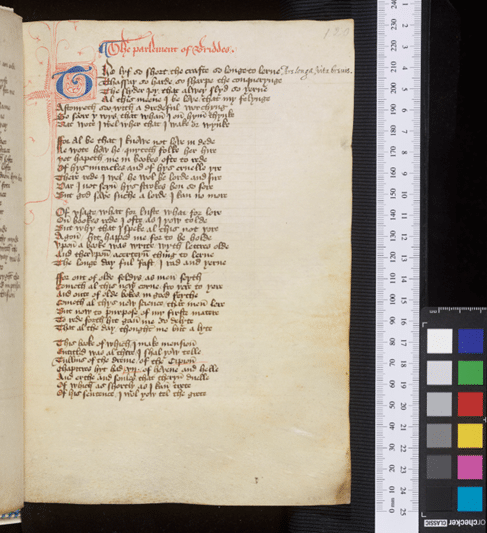
Fast forward to fourteenth-century England and the earliest known explicit association between St Valentine’s Day and romantic pairing appears in the poetry of Geoffrey Chaucer. In Parlement of Foules (c. 1382, pictured), Chaucer writes:
For this was on seynt Valentynes day,
Whan every foul cometh there to chese his make.
Chaucer’s poem’s allegory of love and choice is set on St Valentine’s Day and explicitly links the date with birds’ natural pairing and, by implication, that of human lovers. It changed Valentine’s Day from a saint’s feast with romantic overtones to a romantic custom tied to one specific day.
Within decades, other English poets had latched on to the idea, such as John Gower (a major courtly poet in late 14th-century England) and John Lydgate (a Benedictine monk whose huge poetry output shaped 15th-century English literature).
Charles, Duke of Orléans, wrote the first known Valentine poem in 1415 from his English prison beginning “My very gentle Valentine, Since for me you were born too soon, And I for you was born too late”. He had been captured at the Battle of Agincourt, remained an English prisoner for 25 years and despite composing over 500 poems never saw his wife, Bonne of Armagnac, again (it’s assumed his Valentine poem is to her …).
This French link is interesting. Today’s scholars often trace medieval romantic discourse to origins in the troubadour culture of southern France. Eleventh- and twelfth-century poet-musicians developed a sophisticated lyric language of courtly devotion. And it’s often assumed that later English love traditions simply inherited continental models.
But the evidence suggests something uniquely English – this was the first country where romantic pairing was formally attached to a fixed feast day in the calendar. And the English Valentine tradition differs from the troubadour culture. It is less eroticised but more seasonal. And it is framed around mutual selection rather than the strong troubadour theme of unattainable devotion.
Either way, by the early fifteenth century, English nobles were writing Valentines on 14 February: poems or tokens exchanged between lovers or potential partners. And Valentine lotteries appear in courtly texts from both England and Burgundian France – men and women would draw names to determine their “Valentine” for the year. This was a playful activity but socially significant, especially among the gentry and aristocracy, reinforcing networks of favour via flirtation. It aligns with late medieval English social structures, where affection was increasingly important in marriage, as opposed to purely dynastic considerations.
The Tudor Period: Who needs saints?
You might imagine that Valentine’s Day would collapse during the English Reformation, when Henry VIII dramatically broke with the Roman Catholic Church. He dismantled saints’ cults, suppressed feast days and slashed devotional calendars. Sermons and injunctions explicitly discouraged appealing to saints. And the mechanisms that had kept feast days going – processions, guild observances, parish ales, votive offerings – were curtailed or abolished.
Valentine’s Day survived the Reformation because, by the sixteenth century, its social function no longer depended on the saint whose name it bore. Long before the suppression of saints’ cults, the day had been repurposed as a secular occasion for partner selection and gift exchange and was embedded in household and courtly custom rather than in liturgical observance.
Valentine’s Day required no Mass or prayer but continued informally through letters, verses and gifts, all exchanged on a calendar day. Henry VIII is often said to have declared Valentine’s Day a holiday in 1537 although there’s no evidence of this (and it would be a bit odd given the wider changes he was making). But it’s true that, by the reign of his daughter, Queen Elizabeth I, Valentine customs are recorded as witty and secular. Popular beliefs reinforced these customs, such as the idea that one’s first encounter on Valentine’s morning foretold a future spouse, which owed nothing to theology.
Compare this with the fate of Thomas Becket’s feast day. His cult had become one of the most powerful in medieval England, sustained through three things: 1) pilgrimage to his shrine at Canterbury, 2) the circulation of relics and 3) belief in his active intercession. Precisely because it was so devotional, though, it was very vulnerable to the Reformation. In 1538, Thomas Cromwell arranged for Becket’s shrine to be dismantled, his relics destroyed, his feast suppressed and his name struck from liturgical calendars. And later, under Elizabeth, Tudor homilies would explicitly denounce pilgrimage and saintly intercession as superstition, further stripping feast days of doctrinal legitimacy.
Valentine’s Day, by contrast, survived because it no longer depended on the same shrines and relics: it had already migrated to being a social custom, beyond the reach of doctrinal reform. In fact, under the Tudors, court culture prized gift exchange and symbolic social play, even as overt religious observance was stripped away. These were the conditions under which Valentine’s Day could persist without theological justification.
Valentine goes global
The next major accelerant is print. From the seventeenth century onward, England’s expanding print culture (almanacs and pamphlets) begins to standardise Valentine imagery. And by the eighteenth century, pre-printed Valentine verses were sold in London.
By the nineteenth century, this all explodes as Victorian Britain mass-produces and exports romantic Valentine’s day. The penny post made sending anonymous love notes in Britain feasible. It’s no coincidence that the Victorian period also formalised the engagement ring as a symbol of intent, for all that this was kickstarted by Queen Victoria and Prince Albert and driven by expanding diamond supplies and new industrial jewellery techniques.

The British Empire ensured these “new traditions” circulated globally in English, driven by trade and migration. Americans embraced the ideas and by the mid-nineteenth century, US manufacturers were exporting Valentine cards back to Britain.
An English invention with global reach
Valentine’s Day did not drift organically from pagan fertility to Christian romance to commercial kitsch. It was formalised in medieval England’s literature, sustained through social custom during the radical theological changes of the Tudor Reformation, amplified by print, and exported through English language and power alongside other Victorian social behaviours.
But just as its true history is independent of the church, we can enjoy it independently of how it came about. Love to you all!
Further reading:
Geoffrey Chaucer’s The Parliament of Fowls: https://www.poetryintranslation.com/PITBR/English/Fowls.php, with a short analysis here: https://college.unc.edu/2020/02/chaucer-valentines/
The earliest surviving Valentine’s letter (Margery Brees, 1477): https://www.thisispaston.co.uk/valentine.html
The first Valentine poem by Charles d’Orleans: https://allpoetry.com/poem/15727062-The-first-Valentine-poem-circa-1415-by-Michael-R.-Burch
Sam’s previous article about the Cheapside Hoard, an amazing find of Elizabethan jewellery: https://thehistoryjar.com/2025/10/06/guest-post-monday-how-the-cheapside-hoard-lifted-the-veil-on-elizabethan-society/
The jewellery legacy of the Tudors: https://adventuresofatudornerd.com/2025/09/07/guest-post-gilded-power-the-jewelry-legacy-of-the-tudors-by-sam-mee/
Valentine’s Day in Tudor England: https://www.theanneboleynfiles.com/valentines-day-in-tudor-england/
***
If you like my posts, you’ll love my books! Nothing Proved is my newest, the story of Elizabeth Tudor’s journey from bastard to queen. Get it now through your favorite platform – Amazon, Barnes & Noble, Kobo, Apple, your own independent bookstore, or even directly from me!
(PS Already read it? Did you love it? Then please review it – even just a stars rating! It makes a huge difference in helping new readers find them and would mean the world to me!)
Be First to Comment